Why do I work best when the deadline is close?
Urgency can make the next action unusually clear. That does not prove the delay was necessary; try creating a smaller earlier checkpoint with the same concrete finish.
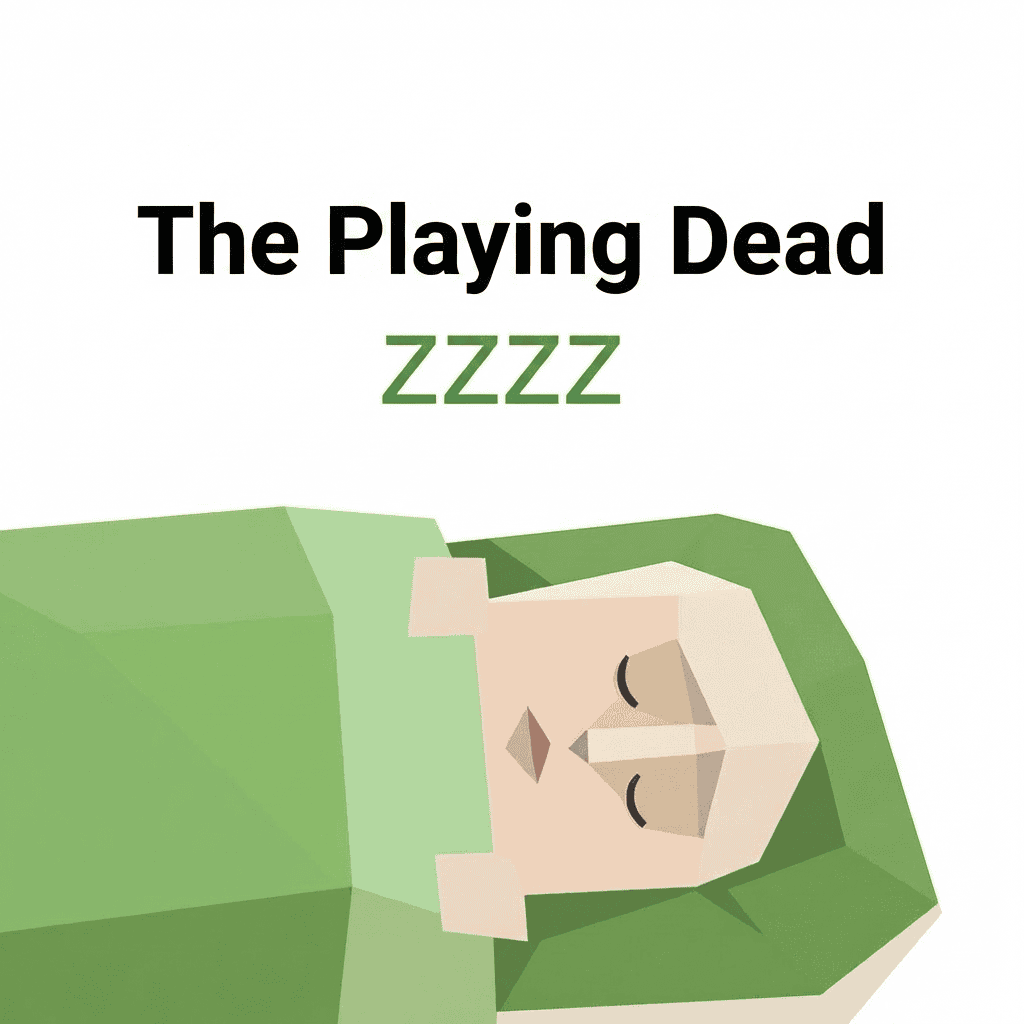
The Playing Dead
I'm not dead. I'm just sleeping.
Lab results are in: you've tested into the rarest playing-dead personality. 99+ unread messages in the group chat? Invisible. But when someone drops an "@everyone — 30 minutes until deadline," you rise from your thousand-year slumber like an ancient mummy, slowly type out "got it," and then produce a passing-grade deliverable in exactly 29 minutes. Yes — only when the Deadline, that singular supreme-authority command, appears do you truly awaken. Silent until the moment of thunder. You've proven a universal truth to the cosmos: sometimes doing nothing means you can't do anything wrong.
MONK may understand protected quiet without demanding a constant social signal. OJBK can enjoy a calm evening that does not need to justify itself with an achievement. Agree on how to acknowledge important messages, so affection does not have to compete with your habit of leaving everything on silent.
A clear deliverable helps you wake up to the task. Create a first checkpoint well before the final deadline so the first mistake is discovered while there is still room to repair it.
For study, use a short practice question at the beginning of a session. It can reveal the real task sooner than reading an entire chapter while waiting for the pressure to become strong enough.
Stillness is often mistaken for having no concern. You may care about the result while struggling to convert a distant requirement into today's action.
You do not need to become permanently busy. The aim is to reduce the price of your late bursts, so a useful capacity for concentrated effort does not require panic, lost sleep, or somebody else's uncertainty.
Urgency can make the next action unusually clear. That does not prove the delay was necessary; try creating a smaller earlier checkpoint with the same concrete finish.
The result cannot determine your feelings. The practical issue is whether someone needs an acknowledgment to make their own plan. A brief honest reply can preserve both quiet and consideration.
Tell the team when you are unavailable and where the next deliverable stands. Rest is easier to respect when it has an agreed boundary rather than an unexplained absence.
Confidence fluctuates with the weather: tailwind and you fly; headwind and you turtle up.
You can feel capable on a good day and doubt yourself after a rushed finish.
You've got a pretty clear read on your temper, desires, and hard limits.
You know which interruptions drain you and which tasks are genuinely yours.
You prioritize comfort and safety — no need to put life in sprint mode every single day.
Comfort and recovery may matter more than another competitive milestone.
Half trust, half suspicion — emotionally you're constantly on a seesaw.
An ambiguous silence in a relationship can make you quietly expect trouble.
Emotionally reserved — the door to your heart isn't closed, the security clearance is just intense.
You conserve emotional expression rather than making every feeling publicly visible.
Space is sacred — even in love, you reserve a plot of land that's yours alone.
You need private space where nobody demands an immediate response.
You view the world through a defensive filter — suspicion first, approach later.
You watch for a catch before trusting the promise behind a new obligation.
Follow rules when it matters; bend them when it doesn't — no needless rigidity.
You use a practical agreement without turning every routine into a rigid ritual.
Low on the meaning meter — a lot of things feel like going through the motions.
The task's meaning can stay faint until its practical consequence becomes visible.
Sometimes you want to win, sometimes you just want to avoid hassle — mixed-motive mode.
You may want a result but often begin by trying to avoid a late penalty.
You think, but not to the point of crashing — standard-issue hesitation.
You can settle on a workable answer after a reasonable comparison.
Execution and deadlines share a deep bond — the later it gets, the harder you awaken.
The approaching deadline often concentrates effort that was previously difficult to summon.
Socially slow to warm up — making the first move usually requires half a day of psyching yourself up.
You prefer a direct invitation over making the first move among strangers.
Strong boundary instincts — get too close and you instinctively step back half a pace.
You keep distance from people who treat a message as a demand for instant access.
You read the room before speaking — balancing honesty and tact.
You consider how to be honest without making the short reply sound dismissive.