Does this type mean I cannot enjoy relationships?
No. A need for space does not rule out affection. The practical question is how to make contact clear enough that both people can trust the arrangement.
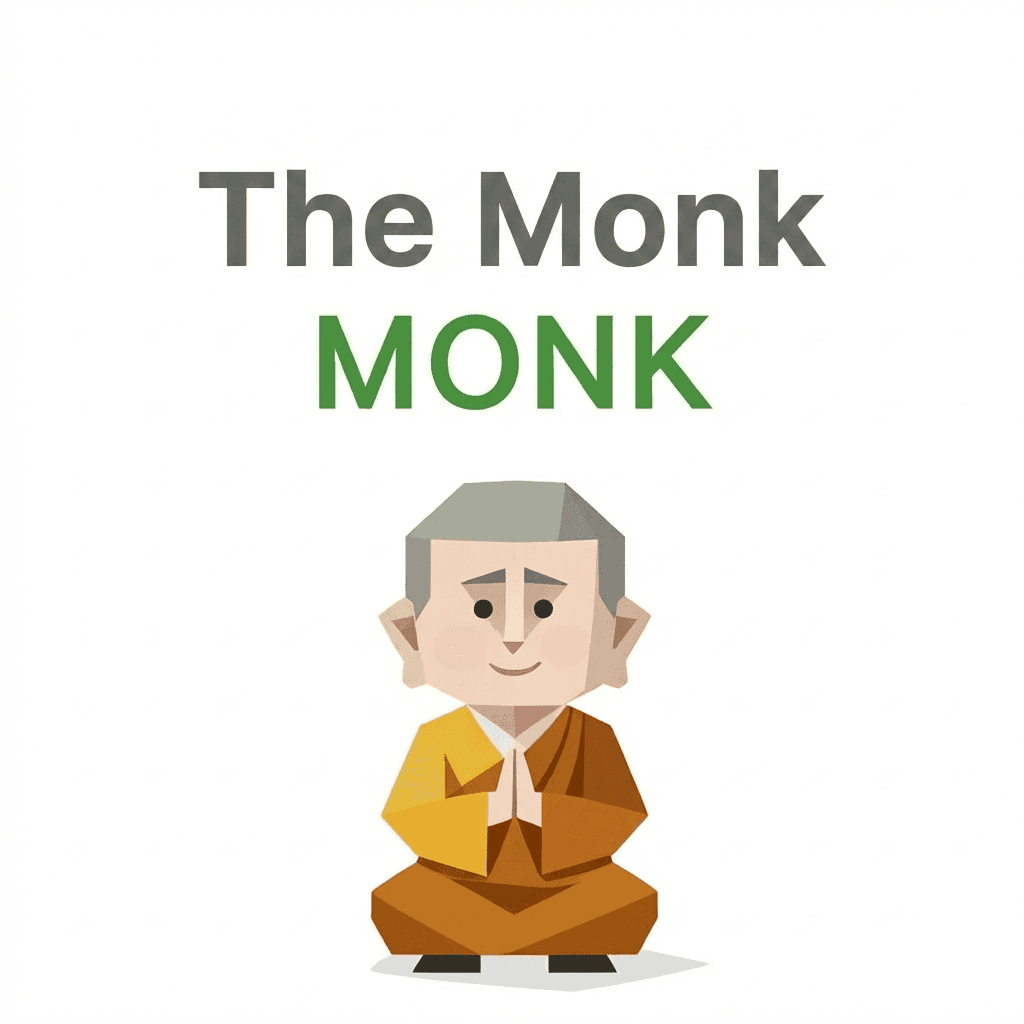
The Monk
Worldly desires? Unsubscribed.
While others seek enlightenment about love and heartbreak at karaoke night, the MONK personality stays home to contemplate the greater truth. MONK has already seen through the illusions of the material world and wants no idle visitors disturbing their meditation or breaking their spiritual focus. MONK's personal space is their sacred barrier, their Mount Sumeru, their absolute territory — violate it at your own risk. Trespassers will feel a suffocating pressure emanating from the depths of their soul. MONKs don't cling and don't entangle, because in their worldview, all things have their own independent orbit. Planets maintain billions of miles between them to create a harmonious universe — why can't people do the same?
SOLO may appreciate a low pressure approach, though silence should not become a contest about who needs less. Dior-s can enjoy uncomplicated routines beside you. Explain how you show care and when you want company, so independence remains an invitation to clarity rather than an unexplained locked door.
Solitary practice and tasks with a clear personal boundary may suit you. Give shared projects an explicit check in so other people do not have to guess the status of your part.
In learning, a quiet setting can reduce distraction, but you still need a source of correction. Choose a limited feedback channel instead of treating every outside response as an unwanted intrusion.
Privacy can be mistaken for disapproval of everyone nearby. You may simply want fewer interruptions, but other people need a usable explanation rather than a philosophy of distance.
You do not need to defend solitude by pretending that companionship has no value. A smaller circle and deliberate contact can fit a private life without turning every human need into an unwanted interruption.
No. A need for space does not rule out affection. The practical question is how to make contact clear enough that both people can trust the arrangement.
It may interrupt a private rhythm you had counted on. Ask for advance notice and offer a realistic alternative rather than requiring someone to discover the boundary through your irritation.
After resting, check whether you can return to the necessary task or conversation. A boundary restores choice; avoidance keeps moving the same issue further away.
You generally know where you stand and won't crumble from a stranger's off-hand remark.
You can feel worthwhile without winning attention from a crowded room.
You've got a pretty clear read on your temper, desires, and hard limits.
You know which contact feels welcome and which demand crosses your limit.
You prioritize comfort and safety — no need to put life in sprint mode every single day.
Comfort and a manageable life can matter more than a public achievement race.
Your relationship alarm system is hair-trigger sensitive — a "seen" with no reply can spiral into a finale.
You may distrust a close connection before anything has clearly gone wrong.
Emotionally reserved — the door to your heart isn't closed, the security clearance is just intense.
You reveal feelings cautiously instead of treating intensity as proof of affection.
Space is sacred — even in love, you reserve a plot of land that's yours alone.
You protect a private area even when you care deeply for someone.
You view the world through a defensive filter — suspicion first, approach later.
You inspect other people's intentions before allowing a demanding connection closer.
If a rule can be sidestepped, it will be — comfort and freedom usually rank first.
You are willing to depart from convention to keep a sustainable rhythm.
Sometimes you have a goal, sometimes you want to slack off — life's OS is half-booted.
The larger purpose may remain faint outside a few personally chosen activities.
Sometimes you want to win, sometimes you just want to avoid hassle — mixed-motive mode.
You can want a useful result while also preferring to avoid unnecessary disturbance.
You think, but not to the point of crashing — standard-issue hesitation.
You compare options without needing to make every small choice a major debate.
Execution and deadlines share a deep bond — the later it gets, the harder you awaken.
Your execution can vary with the available quiet and personal energy.
Socially slow to warm up — making the first move usually requires half a day of psyching yourself up.
You usually prefer a clear invitation to initiating contact with unfamiliar people.
Strong boundary instincts — get too close and you instinctively step back half a pace.
You maintain a strong line around time and private space.
You read the room before speaking — balancing honesty and tact.
You balance a plain answer with some concern about how it will be heard.