Does saying oh no mean I am weak?
No. Noticing risk and feeling alarm are different from being unable to act. Look at what you do after the concern appears, including the small protective steps.
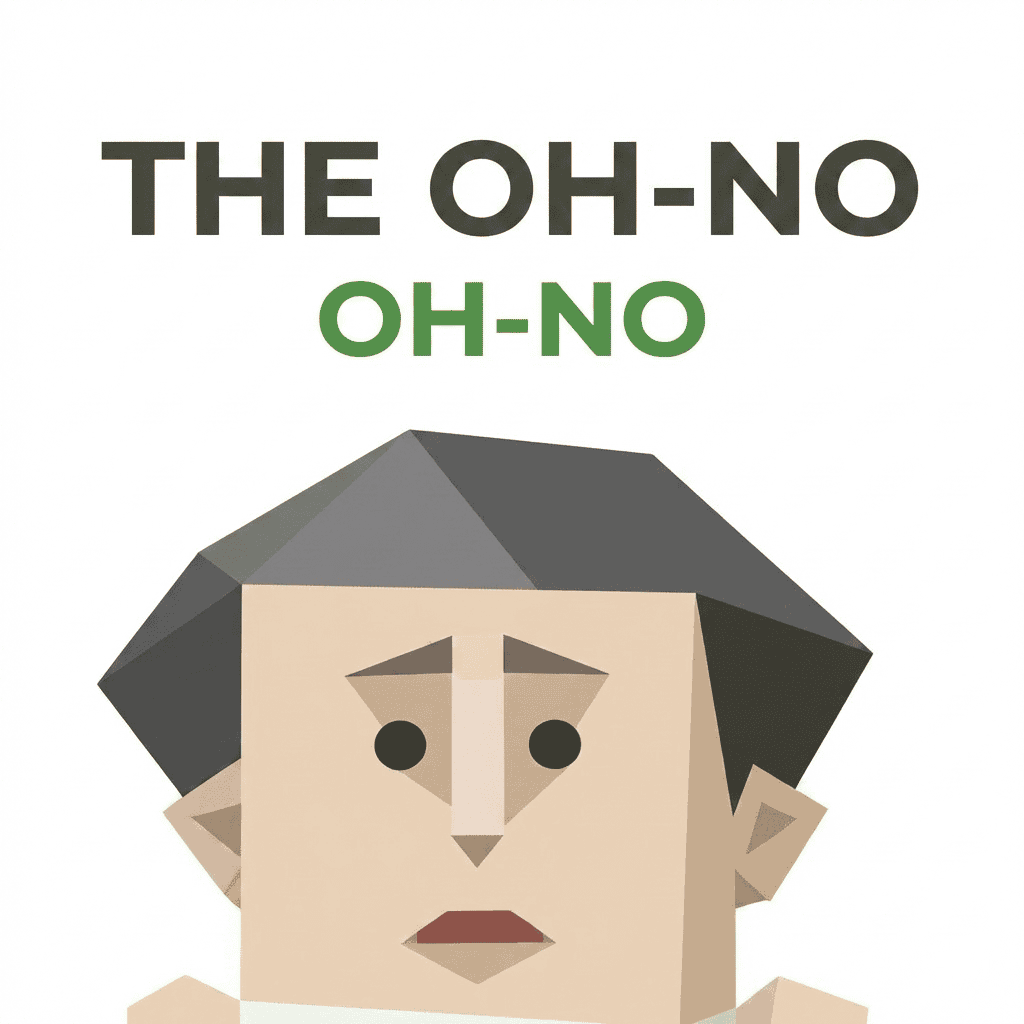
The Oh-No
Oh no! How did I get THIS personality?!
"Oh no!" is not a scream of fear — it's a form of supreme wisdom. When a normal person sees a cup on the edge of a table, the Oh-No person sees an epic disaster chain: water spill → short circuit → fire → building evacuation → economic collapse → butterfly effect → end of the world. And so, with a soul-deep "Oh, no!", they move the cup to the exact center of the table at lightning speed, then place an absorbent coaster under it. The Oh-No personality has an almost obsessive respect for boundaries: yours is yours, mine is mine. Every accident and risk has already been strangled in its cradle by their "Oh, no!" They are the guardian deities of order — the last tightly-wound, dignified people in a chaotic world.
CTRL can help turn a concern into a bounded plan, provided planning does not expand forever. MONK may respect your need for space and a predictable rhythm. Tell a partner what reassurance actually helps; another person cannot reliably answer an alarm whose instructions keep changing.
Your attention is useful in testing, handoffs, and tasks where one overlooked assumption can undo careful work. Distinguish a plausible failure from every imaginable failure.
When studying, test your understanding with a small example rather than rereading every page for a hidden trap. A concrete mistake gives you something narrower and more useful to correct.
Concern can look like a refusal to participate. Explain the risk you see alongside the condition that would let you proceed, so others can hear a path forward.
Your early warning system deserves a volume control. Rest, clear agreements, and a limited review window can help you use the signal without making every ordinary uncertainty the center of the day.
No. Noticing risk and feeling alarm are different from being unable to act. Look at what you do after the concern appears, including the small protective steps.
Specifics reduce the room available for alarming guesses. Ask for the two details that matter most rather than turning every invitation into a complete operational audit.
Compare likelihood and consequence, choose a reasonable safeguard, and decide what evidence would justify revisiting it. More imagined branches do not always add practical protection.
You generally know where you stand and won't crumble from a stranger's off-hand remark.
You can trust your ability to spot a concrete coordination problem.
You've got a pretty clear read on your temper, desires, and hard limits.
You know which details make a situation acceptable for you.
You prioritize comfort and safety — no need to put life in sprint mode every single day.
Avoiding needless discomfort can matter more than winning a prestigious challenge.
Your relationship alarm system is hair-trigger sensitive — a "seen" with no reply can spiral into a finale.
Silence from a close person quickly invites an anxious interpretation.
You invest, but keep an exit strategy — never going full all-in.
You care but may hold some feelings back while checking the situation.
Space is sacred — even in love, you reserve a plot of land that's yours alone.
You want preparation time and a private area that others respect.
You view the world through a defensive filter — suspicion first, approach later.
You inspect the possible catch before accepting a reassuring headline.
Strong sense of order — if there's a process, you'd rather follow it than improvise.
You can adjust a plan when the alternative still protects what matters.
You operate with direction and roughly know which way you're headed.
A clear destination gives your precautions an actual purpose.
Easily ignited by results, growth, and the feeling of forward momentum.
Preventing a mishap can sit beside a strong wish to achieve something.
Decisions come fast and once they're made, you don't look back.
You make a firm choice once the essential safety question is answered.
Can execute, but it depends on timing — sometimes steady, sometimes vibing.
You keep working until the vulnerable handoff has been checked.
Socially slow to warm up — making the first move usually requires half a day of psyching yourself up.
You prefer an explicit invitation before entering a room of strangers.
Strong boundary instincts — get too close and you instinctively step back half a pace.
You step back when another person assumes unlimited closeness.
Express yourself directly — what's inside usually comes straight out.
Your public reaction can be dramatic while your private analysis stays careful.