Am I supposed to be grateful for unfair treatment?
No. You can value someone's earlier help and still challenge their present behavior. Gratitude does not require abandoning a boundary or inventing a benefit in mistreatment.
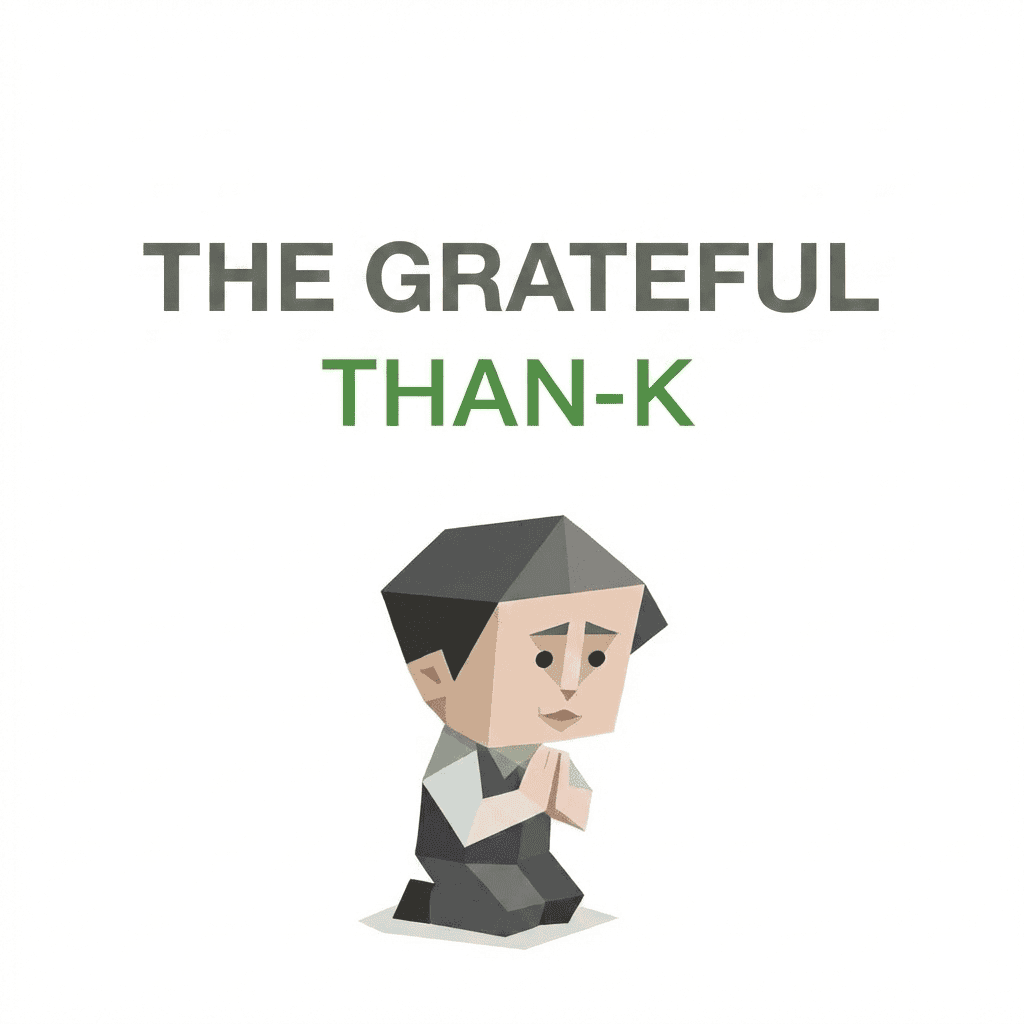
The Grateful
I thank the heavens! I thank the earth!
Diagnosis complete. You've tested into the rarest personality in the land. And you should thank ME for it! Stuck in traffic on your commute? You'd say: I'm grateful for this traffic jam — it gave me time to appreciate this lovely song and admire every anxiety-twisted face outside my window, making me treasure my inner peace even more. Yes, THAN-K has a personality as warm as jade and a heart as vast as the ocean. In their eyes, there are no truly bad people — only "friends who haven't yet been reached by the light of gratitude." Having a THAN-K friend is like having an inexhaustible positive-energy broadcast tower next to you. They could find a Van Gogh-style Starry Night in the mold stain on your bathroom wall.
ATM-er may understand practical care, but appreciation should include protecting their time. MUM can share your attention to small comforts without requiring every sad feeling to disappear. Offer gratitude for a real act rather than praising someone into accepting another favor; warmth works best with permission to disagree.
You help a team notice progress that would otherwise vanish between deadlines. Specific recognition can make a long, ordinary practice session easier to repeat.
In learning, thank a useful explanation by applying it and reporting what worked. You do not need to call every lesson wonderful; honest feedback makes appreciation more credible.
An optimistic response can be mistaken for denying difficulty. Sometimes a person needs you to name the loss before you search for the useful lesson.
Your ability to notice good things is valuable precisely because it is a choice. Leave room for disappointment, uncertainty, and days when the most honest sentence is simply that something hurt.
No. You can value someone's earlier help and still challenge their present behavior. Gratitude does not require abandoning a boundary or inventing a benefit in mistreatment.
Timing matters. Ask whether they want company, practical help, or a different perspective. An immediate bright side can sound like an instruction to stop feeling upset.
Certainly. Anger can identify a violated agreement. Describe the event and the change you need instead of deciding that one difficult emotion invalidates your warm outlook.
Confidence fluctuates with the weather: tailwind and you fly; headwind and you turtle up.
You accept praise warmly while occasionally needing reassurance after a hard day.
You've got a pretty clear read on your temper, desires, and hard limits.
You can name a preference without claiming to understand yourself perfectly.
Want to hustle AND want to chill — your values committee has frequent internal meetings.
Appreciating help does not remove your wish to keep learning.
You'd rather trust the relationship itself and won't be spooked by every little breeze.
A friend's busy afternoon does not erase the care already established.
You invest, but keep an exit strategy — never going full all-in.
You offer encouragement while leaving space for your own emotional reserves.
Need a bit of both closeness and independence — adjustable-dependency type.
You enjoy closeness but can also appreciate an independent afternoon.
More inclined to believe in human goodness — you don't rush to sentence the world to death.
You notice sincere effort before deciding another person is beyond trust.
Strong sense of order — if there's a process, you'd rather follow it than improvise.
You prefer clear agreements so appreciation is not confused with obligation.
Sometimes you have a goal, sometimes you want to slack off — life's OS is half-booted.
A small kindness matters even when your larger direction remains uncertain.
Sometimes you want to win, sometimes you just want to avoid hassle — mixed-motive mode.
You sometimes pursue progress and sometimes simply want tension to settle.
You think, but not to the point of crashing — standard-issue hesitation.
You consider how an answer will land before giving a workable response.
Strong drive to push things across the finish line — open tasks feel like a splinter in your brain.
You follow through on a promised thank you or practical act.
If someone approaches, you engage; if not, you don't force it — moderate social elasticity.
You respond to an opening without always being the first speaker.
Strong boundary instincts — get too close and you instinctively step back half a pace.
You can care deeply while keeping a line around your private time.
Express yourself directly — what's inside usually comes straight out.
Your gratitude is usually stated plainly rather than hidden behind a performance.