Why do I get impatient with planning?
You may find feedback from a real attempt more informative than another abstract debate. Keep the essential safety and dependency checks, then propose a small reversible trial.
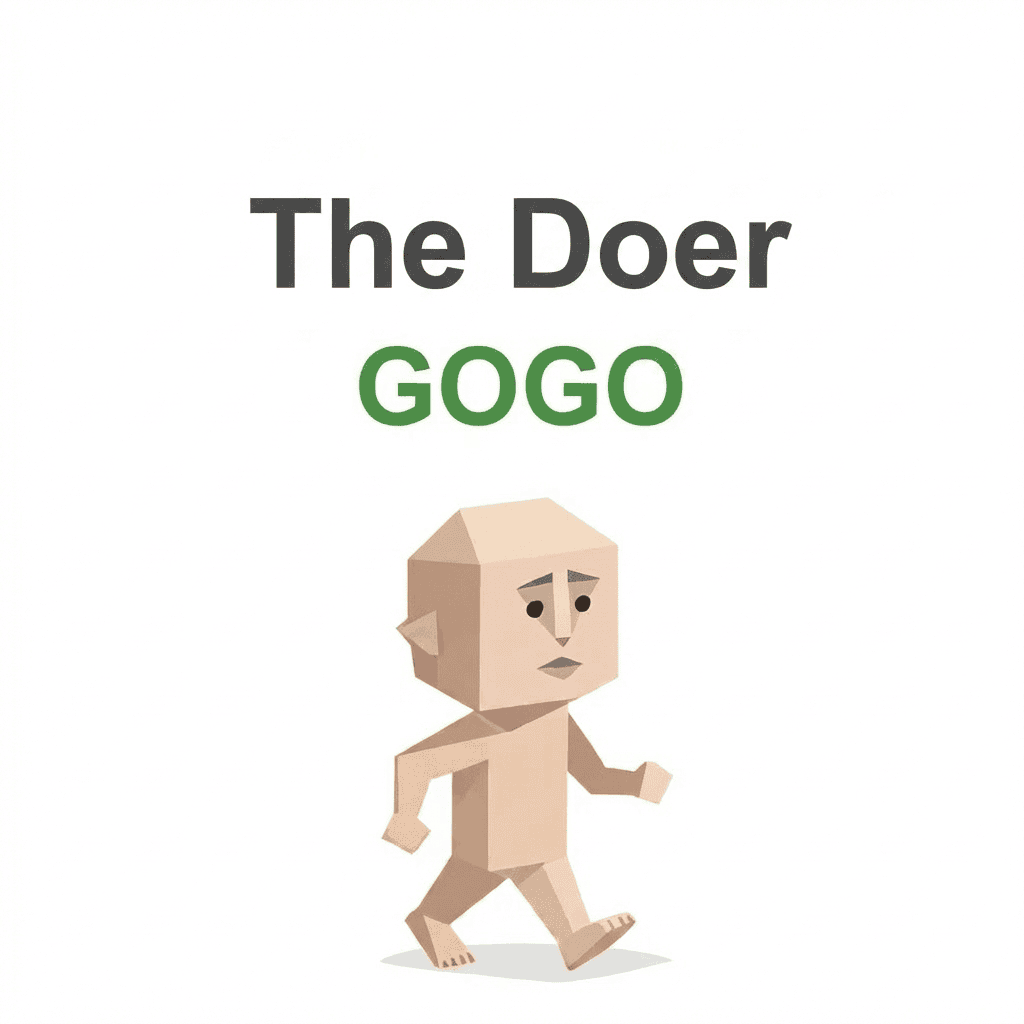
The Doer
Go go go~ Let's move!
Research has found that the GOGO brain is fundamentally different from a normal human's. GOGO lives in an ultimate "what you see is what you get" world, with a life philosophy so brutally simple it's almost offensive: if I close my eyes, it's dark; if I spend all my money, I'm broke; if I'm standing on a crosswalk, I'm a pedestrian. Logic: perfectly circular. Absolutely irrefutable. While others debate whether the chicken or egg came first, the GOGO has already made them both into a "Chicken-and-Egg Ultimate Showdown Rice Bowl." They don't "solve problems" — they "clear to-do lists." To them, the world has only two states: Done, and About To Be Done By Me.
BOSS can help align your speed with a shared destination instead of parallel sprints. OJBK may make ordinary companionship feel less like another race. Ask whether the other person wants action now; practical help can be welcome without becoming a shortcut around listening.
A visible prototype and quick feedback fit your learning rhythm. Keep enough notes that tomorrow's version does not repeat an error you solved today.
For difficult study material, alternate a short explanation with a worked exercise. If the exercise fails, return to the specific concept involved rather than treating speed as evidence that you understood.
For a concrete example, suppose you are building a small inventory sheet. Start with three real items and ask the person who will use it to enter one more. Watch where they hesitate before adding colors, extra columns, or an impressive dashboard. Keep the successful entry as a reference case. If the total is wrong, isolate the calculation before redesigning the whole sheet. This sequence gives your preference for action a useful feedback loop: the next move follows an observed difficulty, and finishing means that the intended user can complete the task, rather than merely that you have stopped editing.
Moving quickly can look careless even when you care a great deal about the result. Show the small checks that protect other people from the cost of your experiment.
Your energy is useful without being permanently available. Deliberate recovery helps distinguish steady progress from a sequence of urgent starts that leave no room to absorb what happened.
You may find feedback from a real attempt more informative than another abstract debate. Keep the essential safety and dependency checks, then propose a small reversible trial.
Only when the result meets the actual need. A fast delivery of the wrong thing creates another task; ask the recipient to show what a useful finish would look like.
Agree on a shared checkpoint and divide tasks by uncertainty. They may need time to inspect a consequence that your first burst of momentum has not yet revealed.
You generally know where you stand and won't crumble from a stranger's off-hand remark.
You can trust a first attempt without requiring universal applause.
You've got a pretty clear read on your temper, desires, and hard limits.
You know which practical problems interest you enough to act.
Want to hustle AND want to chill — your values committee has frequent internal meetings.
You alternate between improvement goals and wanting an uncomplicated afternoon.
You'd rather trust the relationship itself and won't be spooked by every little breeze.
A teammate's quiet response does not automatically mean rejection.
You invest, but keep an exit strategy — never going full all-in.
You care for people without absorbing every emotion into the task.
Space is sacred — even in love, you reserve a plot of land that's yours alone.
You keep room for your own pace while enjoying shared activity.
Neither naive nor full conspiracy theorist — watchful waiting is your default.
You inspect a situation before deciding whether enthusiasm is deserved.
Follow rules when it matters; bend them when it doesn't — no needless rigidity.
You use the useful parts of a process and adjust the rest.
You operate with direction and roughly know which way you're headed.
You want the immediate action connected to a recognizable destination.
Easily ignited by results, growth, and the feeling of forward momentum.
An observable improvement is a strong reason to begin now.
Decisions come fast and once they're made, you don't look back.
You choose a workable experiment without reopening every discarded option.
Strong drive to push things across the finish line — open tasks feel like a splinter in your brain.
You like to carry the useful attempt through to a real finish.
If someone approaches, you engage; if not, you don't force it — moderate social elasticity.
You join an available conversation without needing to organize every gathering.
Strong boundary instincts — get too close and you instinctively step back half a pace.
You can share activity while still keeping some private ground.
You read the room before speaking — balancing honesty and tact.
You balance an honest update with attention to the team's mood.