Does this label say anything about my family?
No. The nickname is not a statement about family history or social worth. Use the tendencies to reflect on distance and connection, not to assign yourself a biography.
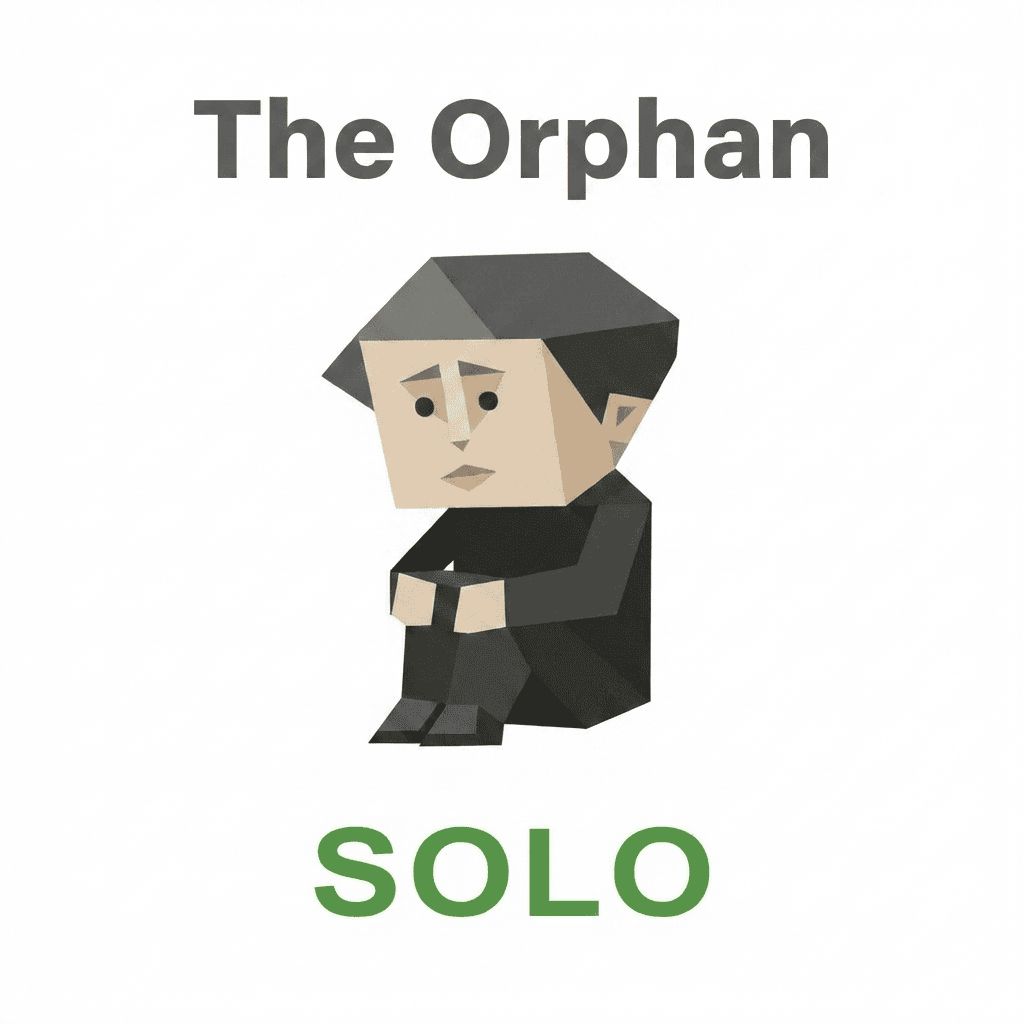
The Orphan
I'm crying. How am I... the orphan?
Congratulations, you've tested into the rarest SOLO - Orphan personality. Don't cry just yet — a king's coronation is usually a solo ceremony. The Orphan's self-worth tends to run low, so they sometimes push others away preemptively. They've built a Great Wall around their soul labeled "DON'T TOUCH ME." Every brick is a scar from the past. The Orphan is like a hedgehog that hides all its soft spots and points every spine at the world. Those thorns aren't weapons — they're unspoken sentences: "Don't come closer, I'm afraid you'll get hurt too" and "Please, don't leave."
MONK may understand privacy without taking it personally, provided neither assumes that needing someone is a failure. MUM can offer a gentle opening without forcing immediate disclosure. Agree on a simple way to ask for contact; closeness should not depend on another person guessing which quiet moment is a hidden request.
Independent tasks may feel safer than uncertain group roles. In shared work, ask for a clearly bounded responsibility and a specific feedback point rather than trying to infer whether you are welcome.
When learning, a private first attempt can lower pressure, but feedback still matters. Choose one trusted person or a limited review format so independence does not leave every uncertainty untested.
Keeping distance can be mistaken for not wanting any connection. A short signal about the contact you do enjoy gives others something more useful than a wall they must interpret.
You can build connection without abandoning your right to space. A few predictable agreements may work better than a dramatic breakthrough, especially when they let both people approach without having to solve a puzzle first.
No. The nickname is not a statement about family history or social worth. Use the tendencies to reflect on distance and connection, not to assign yourself a biography.
Protection and interest can coexist. Try naming one manageable kind of contact instead of requiring yourself to reveal every feeling or remain entirely unreachable.
Offer a specific plan and accept that timing can be inconvenient. A decline of one invitation is information about that invitation, not a complete verdict on the relationship.
Harder on yourself than anyone else — if someone compliments you, you'll fact-check it first.
You may question your worth before a new group has actually responded.
Usually you can recognize yourself, though emotions occasionally hijack your account.
You can recognize some needs while uncertainty makes the answer fluctuate.
You prioritize comfort and safety — no need to put life in sprint mode every single day.
Comfort and protection can outweigh the appeal of another visible achievement.
Your relationship alarm system is hair-trigger sensitive — a "seen" with no reply can spiral into a finale.
A delayed reply can quickly become a feared sign of abandonment.
Emotionally reserved — the door to your heart isn't closed, the security clearance is just intense.
You keep emotional investment guarded until trust feels more established.
Space is sacred — even in love, you reserve a plot of land that's yours alone.
You want a private space that remains yours inside a close connection.
You view the world through a defensive filter — suspicion first, approach later.
You look for a possible rejection before trusting the welcome.
Strong sense of order — if there's a process, you'd rather follow it than improvise.
You prefer a flexible route rather than a social rule that forces exposure.
Low on the meaning meter — a lot of things feel like going through the motions.
A dependable bond can give your choices a meaningful direction.
Your avoid-disaster system activates way before your ambition — risk-aversion leads.
Avoiding humiliation may be a stronger first motive than seeking recognition.
You think, but not to the point of crashing — standard-issue hesitation.
You consider possible responses but can sometimes settle on a workable opening.
Execution and deadlines share a deep bond — the later it gets, the harder you awaken.
You may wait for a deadline or external prompt before sending the message.
Socially slow to warm up — making the first move usually requires half a day of psyching yourself up.
You usually need a clear invitation before approaching an unfamiliar person.
Strong boundary instincts — get too close and you instinctively step back half a pace.
You keep a strong protective line around your personal territory.
You read the room before speaking — balancing honesty and tact.
You weigh the honest answer against the possibility of hurting or being hurt.