Why did I receive the fallback rather than the closest type?
The system still finds a closest ordinary pattern, but when its rounded similarity is below 60 and the priority trigger is absent, the final result is HHHH.
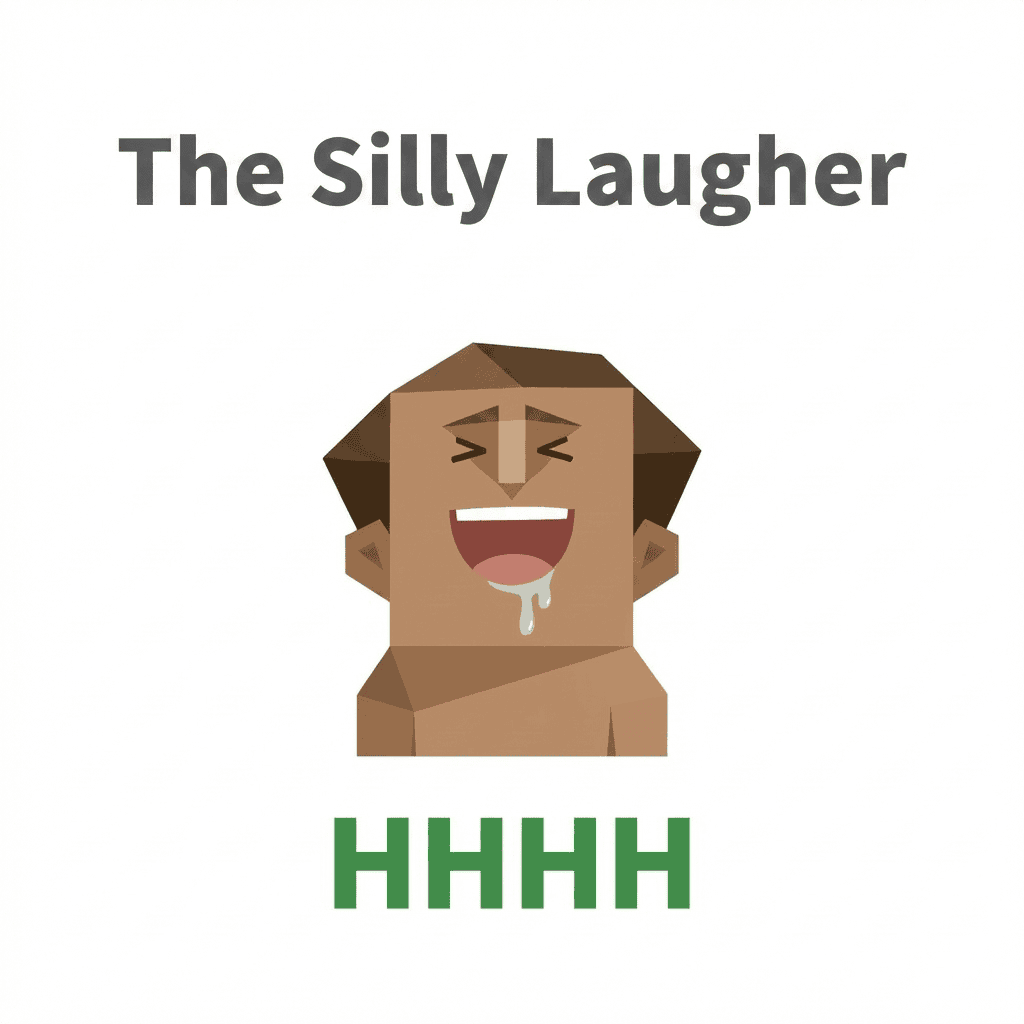
The Silly Laugher
HAHAHAHA. (system error. personality not found.)
Congratulations! Your thought patterns are so bewilderingly unique that the standard personality database has completely crashed. When the top personality match drops below 60%, the system force-assigns you this personality — HHHH - The Silly Laugher. What traits does this personality have? HAHAHAHAHAHAHAHAHAHA! Sorry, that's literally the entire trait description. You can check the fifteen dimensions for an unprofessional assessment. Sincere apologies! The author didn't account for every possibility when designing personalities, which is why this situation exists. HAHAHAHA... laughing and laughing, and then I started crying. How can someone's brain work this way.
FAKE may understand that different settings bring out different sides, while MALO may welcome an unusual combination without rushing to standardize it. These are conversational possibilities rather than computed compatibility claims. Tell a partner which actual needs matter, because the fallback code supplies no fixed relationship blueprint.
An unfamiliar result can be a useful reason to examine specific habits. Choose a recent task and describe how you began, decided, and finished before asking which single label should explain the whole sequence.
In learning, explain one part you understand and one part that remains uncertain. A mixed answer can guide the next useful exercise more precisely than pretending the whole subject is either mastered or impossible.
The fallback is easily mistaken for a rare superpower or a failed test. It is neither conclusion. It says that none of the available ordinary templates crossed the implemented similarity threshold for this set of levels.
You do not have to turn an imperfect fit into a permanent identity. The result is a summary produced by a particular set of questions and templates, while your concrete choices remain available for a more detailed conversation.
The system still finds a closest ordinary pattern, but when its rounded similarity is below 60 and the priority trigger is absent, the final result is HHHH.
No. A finite collection of templates cannot cover every combination equally well. Your dimension answers remain interpretable even when no ordinary label clears the threshold.
There is no requirement to do that. If a question was misunderstood, review it honestly; otherwise the mixed profile may be more useful than a label obtained by steering your responses.
This branch has no fixed pattern. The normal ranking is calculated first, and its closest entry is inspected. If that entry's similarity is below 60, the fallback name is used unless the drinking related priority branch has already selected its own result.
The similarity is calculated from distance between fifteen level values and a normal template, then rounded. It is a matching measure inside this entertainment model, not a probability that you have a particular personality and not a percentage of mental health, intelligence, or human normality.
Your S1, S2, and S3 values still describe different questions: self esteem, clarity about yourself, and the values that move you. A person can be clear about a preference while feeling uncertain about worth. The combination is not a contradiction that the fallback has secretly diagnosed.
Read E1 as security in a bond, E2 as emotional investment, and E3 as space and dependence. Wanting a reliable connection does not establish how much feeling you disclose, and caring deeply does not establish how much uninterrupted personal space you need.
A1, A2, and A3 concern outlook, rules, and meaning. You can distrust an optimistic promise while valuing a clear process, or enjoy flexibility while feeling a strong direction. Use the separate values instead of assuming that all three must move together.
Ac1 distinguishes what motivates a start; Ac2 describes decision style; Ac3 describes execution. Someone can decide quickly and still work in deadline bursts. Look for a recent example with a visible beginning and end before merging these three questions into a single verdict about motivation.
For So1, consider whether you initiate contact. For So2, consider how close you let people come. For So3, consider how expression changes with the audience. A person may greet strangers readily while keeping strong private boundaries, so one vivid social incident cannot establish the entire group.
The nearest normal entry can still serve as a comparison, but it should not be smuggled back in as a fixed pattern for this page. Name the dimensions that fit and the ones that differ, with the same care you would use when comparing two imperfect maps.
A result can shift if an answer moves a dimension across a level boundary. That sensitivity is worth noticing without treating every retest as a discovery of a different hidden self. Keep the question wording, time frame, and circumstances in view when comparing outcomes.
The most useful next step is often descriptive rather than corrective: write what you actually did, what you hoped to protect, and what happened afterward. A concrete account can support a conversation even when the template collection does not offer a satisfying name for it.